'No one is ready for this'

A few years ago, the idea of hackers bringing the world to the brink of catastrophe was just a fun Hollywood plotline. Now, cyber-attacks are on the rise and Nato's top computer experts have gathered in a military base in Estonia to prepare cyberwar defences
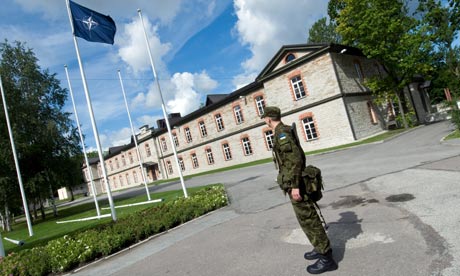
A Nato base in Tallinn, Estonia, established to combat cybercrime

Nato base in Tallinn, Estonia, established to combat cybercrime. Photograph: Christian Sinibaldi

Back in 1983, the world was a simpler place. The economy looked healthy, there were only four channels on the TV - and, if you believed Hollywood at least, the biggest threat to world security was a pimply teenager with a computer. Matthew Broderick's turn in the film WarGames, as a nerdy kid who accidentally blunders into a highly classified computer system that controls the US nuclear arsenal and proceeds to take the world to the brink of nuclear war, didn't win many awards. But it made its mark on millions of people around the world - and introduced us to the stereotype of the precocious young hacker.

The film plugged into every paranoid star-wars fantasy from the Reagan era but now it is unlikely to elicit more than a snigger. The prospect of a cyberwar launched by someone too young to drink is, frankly, ridiculous. Isn't it?


Bobbie Johnson visits the cyberwarfare HQ. Link to this audio In fact, the implications of a cyberwar are, right now, being carefully considered by intelligence chiefs in Britain and around the western world. Their nightmare? A co-ordinated strike that targets businesses, public services, central government, the financial sector and communication systems.

In the worst-case scenario, what might start slowly - a few propaganda messages here, a hacked website there - could quickly spread. The already hammered British economy might soon be crippled as the nation's bank accounts are drained of their funds - stripping billions out of people's hands in seconds - and major online shops including eBay and Amazon fail.

Elsewhere, communications networks could come under fire, with phone, internet and mobile systems quickly collapsing. The transport network might fail, too, causing air-traffic control computers to go haywire, rail systems to break down, traffic light systems to be reprogrammed.

The ensuing chaos would create panic around the country, with airports from Heathrow to Glasgow on high alert, facing the horrifying prospect of midair collisions as the aircraft above them are fed wrong information. While the emergency services struggle to cope with the confusion, they could fall victim to attacks themselves. A stream of fake messages and alerts might send fire engines to the wrong locations, and ambulances to hospitals already filled with patients.

And the coup de grace? Hidden programs inside the country's electricity grid might then jump to life, shutting down power supplies, creating targeted blackouts, even sending nuclear reactors into freefall.

Such a doomsday scenario might sound drastic - more of a cyber-apocalypse than a cyber-attack - but it is one that has been outlined many times by the Metropolitan Police, MI5 and the Joint Intelligence Committee. The US Navy investigator and cybercrime specialist Kenneth Geers characterises the typical response of powerful individuals as they hear this doomsday scenario outlined as a sort of unbridled terror inspired by technology. "More than one senior official said they've had so many cyber-briefings now that they don't want to turn their computers on any more," he says.

Geers identifies a number of potential weak spots in the system, including websites of "pure economic value" (such as banks and online shops) as well as telecommunications systems and the electricity grid.

"In the worst case? [Someone] invading your own infrastructure and using your own tools against you," he says. "Tell your troops to move in the wrong direction, or your missiles to fire on your own cities ... anything in your imagination."

Hidden in the shadow of crumbling Soviet tower blocks on the outskirts of the Estonian capital Tallinn sits a compact military post that looks pretty much like any other. The base carries the official name of Cooperative Cyber Defence Centre of Excellence, but is usually referred to by the code name K5. Soldiers march across the small parade ground, passing a selection of camouflaged vehicles as they troop to and fro. Heavy weaponry is dotted around the buildings, while on one side of the plot a discreet armoury holds a stock of emergency weapons.

Behind the security gates and razor wire, however, this is a different kind of military operation - the unlikely frontline in Nato's attempt to prevent a global cyberwar. K5 is where the alliance's top computer experts - high-ranking researchers, academics and security specialists - work in teams to analyse potential cyberthreats, and predict exactly how Nato will fight virtual wars in the future.

Since the centre opened last year, few people have been granted a glimpse inside - but I am being given the chance to see exactly what takes place here. And so I find myself standing opposite Rain Ottis, a stout, serious-looking Estonian computer scientist who speaks flawless English, in the corner of K5's mess room. It would be easy to forget that this is a military station were it not for the fact he is wearing fatigues. I'm holding a cup of weak coffee in a Nato mug, and watching as a light rain starts falling on the barracks next door.
Ottis speaks with a calm voice, but is forceful about how we might need to respond to a future cyber-strike. His solution? Overwhelming response: a single, gigantic counter-strike that cripples the target and warns anyone else off launching a future cyberwar. He isn't sure what it would look like, but the show of force he envisages is so severe that the only thing he can compare it to is a nuclear attack - meaning, of course, that K5 could be the virtual equivalent of the Manhattan Project, the US-led secret programme to develop the atomic bomb.

"Obviously nuclear weapons do a lot more damage than a cyber-weapon would do in a physical sense - but a single cyber-weapon could have global consequences," he says. It feels as if we have come full circle from the contrived Hollywood paranoia of WarGames.

Fears over computerised warfare stretch back many years, but it was only in the early 1990s - when the internet started to become a more widely accepted technology - that researchers at Rand, the Pentagon thinktank, first coined the term "cyberwar". In a prescient 1993 paper, "Cyberwar is coming!", the analysts John Arquilla and David Ronfeldt argued that an online battle waged between two nations was almost inevitable - but that at least it would be less destructive than full-blown conflict.

Many of the cyber-attacks that have been identified in recent years have been linked back to China, which now has more internet users than anywhere in the world, and Russia. The growing animosity surrounding these reported strikes is developing into a new sort of cold war, played out by teams of cyber-spies sitting at computers in opposite corners of the globe.

Recent examples that have raised the tension include a hi-tech spy group known as Titan Rain, which successfully infected government computers in Britain, America and Germany, and GhostNet, a cyber-espionage network which targeted supporters of a free Tibet. Both were said to come from China, and possibly be directly linked to the People's Liberation Army - although researchers couldn't agree on the evidence. University of Cambridge researchers claim it was definitely the product of "agents of the Chinese government", while their colleagues at the University of Toronto say that it is too easy to presume guilt.
"Certainly Chinese cyber-espionage is a major global concern," the Canadian experts wrote in a report on GhostNet. "But attributing all Chinese malware to deliberate or targeted intelligence-gathering operations by the Chinese state is wrong and misleading."

Then, last week, it was widely reported that the US's power grid had succumbed to hackers. Given that America's security services are scrabbling for the attention of their new president, there's plenty of reason to be sceptical about these unsubstantiated and largely anonymous reports (American security whizz Kevin Poulsen says the timing of this uncheckable story is "unusually opportune"). Regardless, such stories are enough to convince the powers-that-be to take action: last week it emerged that the US Congress is considering legislation to massively increase the country's cyber-defences - including, potentially, a single official who is in charge of keeping civil systems, military networks and public utilities safe.

Inside Nato's own cyber-defence HQ in Estonia, the day-to-day business at K5 largely involves people staring at computer screens. Those expecting a vast, hi-tech control centre worthy of Nasa would probably be disappointed by the austere surroundings, which look more like they were lifted from a university hall than MI5 headquarters. Essentially, the centre is a hybrid of a global listening post and a thinktank. The 30 experts stationed here are tasked with gathering and processing intelligence and information, then giving scientists the information to simulate possible responses to cyber-attack.

The group is drawn from a range of Nato countries, and they spend their days analysing data that streams in from around the internet. One of those stationed at K5 is Geers, the author of a book called Cyber Jihad and the Globalisation of Warfare. Tall, slim, dark-haired and wearing civilian clothes, he tells me that we are paying the price for a headlong rush into using technologies without thinking through the potential consequences.

"In certain ways, this is a golden age for attackers," he says, in a careful voice. "Over the past 15 years, the world has rushed to connect networks together because they want to use their power. But the rush to connect everything to the internet was ahead of security."

With so much of the world now connected to the internet - billions of computers and mobile phones across a multitude of homes, banks, schools, shops and elsewhere - it is ripe for attackers to exploit the gaps in security. "It's a very big challenge for us to be able to leverage networks and the power of computers, while at the same time securing them."

In a side room, Geers' colleague Ottis tells me: "Espionage is something that countries and governments accept - it's always been there, and always will. But if we see attacks that target the citizen? That's different."
There is a particular reason for Ottis and his fellow Estonians to be concerned about the threat of cyberwar: in 2007, Estonia itself was the target of a massive internet assault, allegedly sparked by a political disagreement with Russia. Over the course of several weeks, Estonia's government, banking and commercial sectors endured a sustained barrage of online attacks that brought parts of the system - one of the most advanced and internet-friendly in the world - grinding to a halt.

Although the Estonians imply that the campaign was sponsored by the Kremlin, K5 officials admit they can offer no proof. But whoever was ultimately responsible, the strikes highlighted fears that technology is the weapon at the forefront of a new sort of cold war.

"This is definitely not science fiction any more," says Ottis. "We have plenty of examples where nation states have actually been involved - both on the offensive and the defensive side. Cyber-attacks are very efficient. You don't have to fly to the country you're attacking, you don't need a cell somewhere. All you need is a connection. What happens if your country gets targeted by 25,000 well-equipped, well-trained people who work to achieve the same goal? No country is ready for that."

The first step towards a proper cyber-defence is understanding who the actors behind a potential attack might be. But doing that requires information which, for the most part, is impossible to find. "Defence against cyberwarfare is extremely difficult," explains Peter Sommer, a computer security specialist and visiting professor at the London School of Economics. "Only the very unskilled leave pointers to their identities and locations."

Skilled hackers can implant targeted viruses inside their victim's computers and leave them to gestate for weeks, months or even years before activating them at a later date. There are numerous examples of such vast, destructive virus strikes - most notably the Conficker worm, which has infected more than 9m PCs worldwide in recent months. Right now nobody knows who created Conficker, or what its target might be. It has yet to fully activate, leaving security groups and antivirus companies on high alert. Some have suggested it is part of a criminal plan to steal identities by the million, or a dangerous cyber-weapon, or that it could simply be a gigantic prank. But even if the worm does prove the spark that ignites a full-blown cyber-conflict, its author would remain almost untraceable.

Just as any hard evidence to suggest the Russian military approved the Estonian cyberattack in 2007 is largely missing, so proving that China or Russia are directly responsible for other attacks is almost impossible. And, experts admit, it would be politically smart for a truly destructive organisation to mask their attacks and make them seem like they originated from a country already under scrutiny.

In truth, it could be almost anybody, almost anywhere. Rudimentary hackers' toolkits are available to buy cheaply online, while an illicit black-market trade in more complex tools takes would-be attackers out of the reach of the authorities on the so-called "darknet". And while a highly intelligent virus such as Conficker may have required some skill to program, other hackers may succeed simply by having the time to experiment rather than any great raw ability. (Gary McKinnon, the Briton accused of hacking into Pentagon computers, bumbled his way into supposedly secure networks by guessing that the password had not been changed from the default "password").

There is also an increasingly blurred line between what action the state sponsors (which would qualify as full-blown international conflict) and what is being done in the name of the state - a sort of guerrilla warfare played out on virtual battlefields. With China's growing power leading to widespread suspicion and criticism in the western media, these groups - a mixture of roguish hackers, disaffected teens and intellectuals frustrated by stereotypes about their culture - see part of their job as defending the homeland, even while they reserve the right to criticise it from the inside.

Rebecca MacKinnon, a Hong Kong-based journalist and academic, has identified this burgeoning ideology as "cyber-tarianism" - where highly connected citizens are critical of government repression but fiercely nationalistic at the same time.

"A lot of people don't want a western-style democracy," she told a conference in California last month. "Before the Olympics last year, Chinese students protested all over the world at what they saw as biased western media accounts." These protests included a series of large-scale hacking attacks - on large targets such as the news channel CNN, and small ones such as pro-Tibet websites, which temporarily disabled them.
In China and Russia, this cyberforce is reckoned to be becoming more powerful - and more destructive. Dissident Russian nationalists have also been blamed for the Estonia attacks, while similar groups are appearing in other countries around the globe as internet connectivity spreads. Armed with technical know-how and a passionate cause, these ad hoc groups of individuals would seem increasingly important in the way these conflicts are playing out.

But it's still difficult to imagine what would actually happen if a full-blown cyberwar ever did take place. After all, movies like WarGames - stuffed with Hollywood exaggerations - surely stretch the limits of what can happen. Don't they?

Twitter spoofing: The next logical exploit

First it was spoofing e-mail, then IM, and now spoofing Twitter is the new means of exploit. How attractive really is the ROI for attackers?

I just completed an article titled "URL shortening: Yet another security risk", in which I discussed URL shortening and how phishers/attackers subverted it to drive unsuspecting users to malicious Web sites.
After reading the many comments, I was happy to note that in general users are getting savvier about misdirection exploits.
This appears to apply to Twitter as well, even though messages or tweets, with shortened links make it more vulnerable.
Fortunately, Twitter has an additional advantage in that we the users get to pick who can send us tweets. This capability significantly reduces the risk simply because you know who's sending you the message.
Well, maybe not
I've just finished reading an article by Washington Post's Brian Krebs titled "Twitter security hole left accounts open to hijack". It seems that it's not that difficult to spoof Twitter messages.
Krebs quoted Lance James a security researcher and author of "Phishing exposed":
"Anyone could authenticate and hijack a Twitter account by using SMS spoofing services, such as my-cool-sms.com, or phonytext.com. These Web sites allow users to mask what phone number they are texting from by letting the user input whatever phone number they want to appear in the from field."
Oh great, this totally negates the one advantage that Twitter had over IM and e-mail. It's not hard to see that phishers/attackers would want to leverage SMS spoofing along with URL shortening to redirect victims to malicious Web sites.
Help from the cellular network operators
One good thing that Krebs alluded to was the fact that SMS spoofing may only work if the attacker is located outside of the United States:
"Twitter co-founder Biz Stone wrote in an e-mail.[Mobile] carriers in the U.S. have their own systems for blocking SMS spoofing. Indeed, most U.S.-based mobile carriers have put in place measures to block SMS spoofing on their networks. But this is generally not the case for international mobile networks."
It appears that United States is one of the few countries forcing cellular carriers to clamp down on SMS spoofing. That's great, but spoofing Twitter messages is still possible just about everywhere else. I'll give you two guesses where most phishing and malware exploits originate, and the first one doesn't count.
Proof of concept
H Security (a German security company) verified that SMS spoofing works in an article titled "Twitter spoofing fix fails in UK and Germany". The article provides the following details of the process:
"In the UK, we had a mobile phone associated with a Twitter account. By taking only the number of the mobile phone and setting it as the sender field on PhonyText then sending an SMS to +447624801423, the UK number for sending SMS tweets, we were able to see our message appear in the tweets on the honline page."

The article goes on to explain what this potentially means:
We then promptly removed the association between the phone and the Twitter account. An attacker could have created a message directing followers to malware sites, to other risky locations on the web, or posted tweets designed to ruin the reputation of the account owner."
What this means
First, the ability to spoof a Twitter message enhances all the normal misdirection schemes that are already in play. The fact that shortened URLs are common place in Twitter messages makes it even easier to pull the scheme off.
The damages from the SMS spoofing and URL shortening exploit can be as simple as malware being loaded on victims' computers to as complex as stealing sensitive financial information from the victims. Also a cruel joke could be played on Twitter accounts that don't have unlimited texting. It would be easy to run up some monster phone bills as noted in the Twitter support section:
"Twitter charges you nothing, but how much it costs to use Twitter with text messaging depends on your text messaging plan. Standard text messaging rates (such as international text messaging fees) do apply. Consult your service provider to ensure that your text plan covers your Twitter usage. If you're using our international number, give your provider the Twitter phone number you'll be using to see if you'll incur extra charges. If you're using Twitter from outside of the US, please consult your carrier, as every provider has a different policy."
Final thoughts
Following spoofing's logical progression was easy for the phishers and malware creators of the world. Yet, from the comments I've read, it seems like it's getting harder for them to find chinks in the armor. That's good and should be heartening to all of the people who are trying to keep the Internet the amazing place it is.
Still, there needs to be awareness and vigilance as long as the possibility of a ROI is perceived by the dark side.

Hacker intrusion on US power grid sparks security fears

Spies hacked into the US electric grid and left behind computer programmes that would let them disrupt service, exposing potentially catastrophic vulnerabilities in key pieces of national infrastructure, The Associated Press has learned.

The intrusions were discovered after electric companies gave the government permission to audit their systems, a former US government official told the AP. The ex-official was not authorised to discuss the matter and spoke on condition of anonymity.

The inspections of the electric grid were triggered by fears over a March 2007 video from the Idaho National Laboratory, which had staged a demonstration of what damage hackers could do if they seized control of a crucial part of the electric grid. The video showed a power turbine spinning out of control until it became a smoking hulk and shut down.

Although the resulting audits turned up evidence of spying, the former official told the AP that the extent of the problem is unknown, because the government does not have blanket authority to examine other electric systems.

"The vulnerability may be bigger than we think," the official said, adding that the level of sophistication necessary to pull off such intrusions is so high that it is "almost without a doubt" done by state sponsors.

The Wall Street Journal, which reported the intrusions earlier, said officials believe the spies have not yet sought to damage the nation's electric grid, but that they likely would try in a war or another crisis.

Chinese and Russian officials have denied involvement in hacks on US systems.

The attacks highlight serious problems that utilities like power and water companies face as they add more technologies for remotely managing their facilities. Any system networked to the rest of the world - from financial systems to university records to retail operations - can leave openings for hackers.

Homeland Security spokeswoman Amy Kudwa said her department is "not aware of any disruptions to the power grid caused by deliberate cyber activity here in the United States".

Even so, congressional investigators and intelligence officials have warned that electric utilities are vulnerable to cyber attacks, and utilities acknowledge that their computer networks are routinely under assault.

CIA analyst Tom Donahue told utility engineers at a conference last year that in other countries, hackers had broken into electric utilities and demanded payments before disrupting power - in one case turning off the lights in multiple cities.

The power grid is becoming a bigger target for hackers as more pieces of it are connected to each other or, in some cases, to the internet.

Employees who work remotely can be a major point of weakness. If their computers can be compromised, hackers can begin working backward into a utility's central control system. One way that's done is by so-called "spear phishing," or trying to fool people into opening personalised emails that have malicious programmes inside them. Malicious Web applications can be another route for hackers.

"The severity of what we're seeing is off the charts," said Tom Kellermann, vice president of security awareness for Core Security Technologies and a member of the Commission on Cyber Security that is advising President Barack Obama.

"Most of the critical infrastructure in the US has been penetrated to the root by state actors."

Joe Weiss, a security expert who has testified before Congress about such threats, said the industry has failed to address these vulnerabilities.

"The human resources computer system in a utility happens to be more cyber-secure than any power plant or electric substation that we have," said Weiss, managing partner of Applied Control Solutions, a company based in Cupertino, California.

"The fundamental problem is that we're paying more attention to the cybersecurity of Facebook than we are to trying to keep our lights on."

He said the long-term ramifications of such an attack would be severe: If electrical equipment were destroyed, power could be lost for six to nine months, because the replacement gear would take so long to manufacture.

Power grid operators acknowledged yesterday that they have been the target of frequent computer attacks and said they are working closely with authorities to lock down their networks.

James Fama, the Edison Electric Institute's executive director of energy delivery, said in a statement that "protecting the electrical grid and keeping the power flowing is our industry's top priority".

Members of Congress and government agencies have sought to increase oversight of the industry. A bipartisan bill introduced last week in Congress would let the president declare a "cybersecurity emergency" if necessary and shut down internet traffic to a compromised piece of critical infrastructure such as the power grid.

Securing power systems against cyber attacks might get even more complicated with the development of so-called "smart grids."

Smarter grids are being built to make electricity delivery far more efficient, saving precious resources. But they require the extension of two-way digital communications down to "smart meters" at homes and new digital sensors to track real-time power usage. Extra nodes on a network can become new openings for spies.

"The more you push communications, intelligence (across the grid) ... you're adding some level of risk," said Brian Seal, a senior project manager involved in power delivery at the Electric Power Research Institute, an industry-sponsored research group.

Kudwa, the Homeland Security spokeswoman, said the government is "working to ensure that security is built in as we develop the next generation of smart grid networks."

And Seal noted that smart grids will give the power transmission system greater resilience and flexibility to reduce the impact of a disruptive event - such as a cyber attack.

Exploring Hacker Culture

By Brett Featherstone

CODE CRACKING
CODE CRACKING: Pwn2own contestants at the CanSecWest Computer and Information Security Conference in Vancouver, British Columbia. (Garrett Gee http://garrettgee.com)
VANCOUVER—Hackers. They’re wizards of electronic information. We often view them as nefarious individuals whose work can have the potential to devastate millions.  But did you know that some also work hard to protect you? Kris Constable of PrivaSecTech, a Canadian computer privacy and security firm, spoke to The Epoch Times about the culture of computer and information security experts or “hackers.”
“One of the more popular terms is white hat or black hat. A white hat is someone who uses their computer security skills for good, and a black hat is someone who uses their security skills for malicious intent,” he explains
Mistakes in software, internet browsers, operating systems and cell phones are called “bugs.” Once a bug is found, depending on who finds it, a program of malicious code—called an ‘exploit’—can be written to crack the program open and make it do something the owner didn’t intend. The severity of exploits vary from those which cause total collapse, to localized headaches. Some hackers write exploits, some write “patches” to defend against them and others actually pull the trigger and put them into use.
Researchers at Tipping Point, a Texas based computer security firm believe that “in reality, the number of benevolent researchers with the expertise required to discover a software vulnerability is a sizeable, and fast growing group.”
However, Constable adds, “The line is not very clear because you have to understand how the bad guys operate which is from experience on the more nefarious side of things…you have to be one step ahead of them, if you will.” For this reason, information security experts themselves cover a wide, populated zone that’s neither black nor white.
“I hate the color metaphor because it’s all gray,” Dragos Ruiu told The Epoch Times at the computer and information security conference he hosts four times a year in Tokyo, Buenos Aires, London and Vancouver, one of the most significant of its kind. “All the information is dual purpose—it can be used for good and bad.  It just depends on the intent of the people and you can't really tell by talking to someone whether they use this stuff for good or bad. Sure you can say someone is clearly … a bad guy doing bad things but sometimes even good people doing good things inadvertently do things that can be harmful.”

Zero Day, Exploits and Script Kiddies

Once an exploit has been written, the author has to decide what to do next. What he does with it says a lot about what kind of person he is. According to Constable, many with superior talent in computer security only want the recognition and satisfaction that comes with such poignant success.
After finding a backdoor into a system used by millions, some people hand this knowledge over to the company to fix without accepting any reward. In these cases, the feeling that they’re doing the right thing is reward enough. Power, in these cases, does not corrupt.
Others leverage their power for their own gain. An enterprising hacker can sell his (rarely her) knowledge of the bug back to the company for what’s essentially a ransom. This kind of deal must be struck before the company’s team discovers the flaw themselves and before the exploit is either put into use by the author or published on the Web on what’s called a “zero day.”
According to Constable, a zero day is when a malicious exploit is released to the hacker community before companies even have a warning that it’s coming. The exploit author himself rarely pulls the trigger on these disruptive programs. Individuals who actually do send out these programs are called “script kiddies.” They are usually kids without a clue out for a joy ride.

Constable says that sometimes exploit authors do pull the trigger. Some hackers are paid to write exploits for intended targets, like governments or corporations, or specific individuals.
The exploit can also go to the underground market and be sold at an invitation-only auction Web site where the buyers identities are entirely unknown.
“Some people write exploits to sell, as a business model; some people write exploits for fun, others just to be malicious. For others, it’s a reputation based thing,” Constable explained.

Industry Rewards for Hacking Skills

More than one thousand hackers attended Chaos Communication Camp on a former Soviet airbase near Berlin, for four days to share software, ideas and discussions. (Sean Gallup/Getty Images)
There is now another choice for the, according to some estimates, less than 100 people in the world with enough skill to find and exploit new bugs. Tipping Point, a computer security firm in Austin Texas, began the Zero Day Initiative (ZDI) to “reward security researchers for responsibly disclosing vulnerabilities.” The company specializes in buying knowledge of software mistakes from individuals and then selling that knowledge back to the affected company. This business model allows the affected companies to keep a lid on crises while still appeasing the desire for reputation and monetary reward. Who says being responsible doesn’t pay?
At the recent CanSecWest Computer and Information Security Conference in Vancouver, British Columbia, the third-ever Pwn2Own contest sponsored by Tipping Point’s ZDI challenged security “researchers” to break into the most recent versions of Internet Explorer, Firefox, and Safari browsers, plus an iPhone, a BlackBerry, a Google Android and the Windows CE smartphone.
In a conference room at the Sheraton Wall Center in downtown Vancouver, otherwise average looking guys quietly hunched over some otherwise normal-looking electronic devices, bending and unraveling the communication systems we rely on every day.
The reward for breaking and entering into these state-of-the-art systems? It’s $5,000 to $10,000, in addition to owning the hacked device. And it doesn’t take these individuals long to meet their objective. In 2008, one man cracked the MacBook Air in under 2 minutes.
The Pwn2Own prize money sounds pretty enticing, but Constable says that $10,000 is actually a small carrot compared to many of the ZDI’s dealings. So why would hackers choose this route to cash in on their talents?
“Realistically, the black market, the underground market, is way more than what ZDI offers. ZDI is only giving you a fraction of what their getting but they’re saving you the time and hassle of negotiating with those companies,” he says.